
Agentic Search: Why Live Retrieval Is Displacing the Index
By Seekora Editor
July 13, 2026
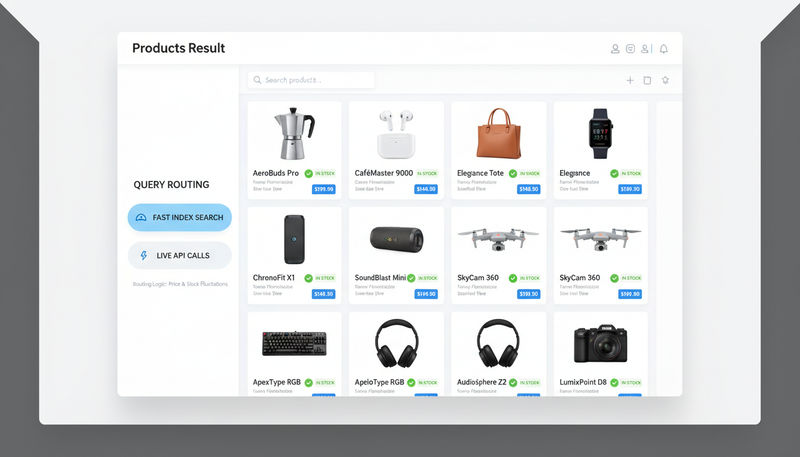
For two decades, search meant one pipeline: crawl the data, build an index, rank against the copy. That architecture powered everything from web search to the search bar on a 40,000-SKU storefront, and it worked because the consumer was a human who could tolerate a slightly stale answer. AI agents cannot. When a shopping agent quotes a price, verifies stock, and moves to checkout in one automated pass, the index it queried is no longer the source of truth - the live system is. This is the shift behind agentic search: retrieval that reasons about where to look and calls source APIs at query time instead of trusting a mirror. Teams building for agent-driven commerce are not discarding their indexes. They are demoting them: millisecond lookups stay in charge of stable attributes, while live calls take over the volatile ones like price, inventory, and promotions. The evidence for that hybrid split is piling up fast, and it comes from enterprise search, coding agents, and commerce protocols all at once.
What Agentic Search Changes About Retrieval
Classic search treats retrieval as a batch problem. Data gets crawled on a schedule, transformed into an index, and every query runs against that mirrored copy. Freshness is bounded by sync cadence. Relevance is bounded by whatever the index captured.
Agentic search inverts the model. It descends from the ReAct framework published by Princeton and Google researchers in 2022, which formalized the loop most agent systems now run: think about what information the task needs, act by calling a tool or API, observe the response, and loop again if the results are thin - all bounded by step, cost, or timeout budgets. Retrieval becomes a decision the agent makes per query, not a pipeline someone configured last quarter.
Moveworks describes this pattern in its account of moving enterprise search from indexing to agentic reasoning. For a question like "what is the updated PTO policy," its agent queries Workday, Confluence, and HR Slack channels in parallel through their native APIs at query time, with no pre-indexing and no duplication of data into a mirrored store.
The pattern is spreading beyond enterprise knowledge bases. Boris Cherny, the creator of Claude Code, confirmed in January 2026 that early versions of the product used RAG with a local vector database, but the team "found pretty quickly that agentic search generally works better," calling it simpler and free of the index's issues around security, privacy, staleness, and reliability.
For commerce, the takeaway is narrower and more useful: an agent that can call a live pricing endpoint has no reason to trust an indexed price from forty minutes ago.
The Staleness Problem in Commerce Catalogs
Product catalogs drift constantly. Prices move with promotions and repricing engines. Inventory counts change with every order, return, and warehouse sync. Availability flips region by region. A nightly reindex - or even an hourly one - guarantees that some fraction of what search returns is already wrong by the time it renders.
The scale of the underlying problem is enormous. IHL Group's 2025 research estimates inventory distortion - out-of-stocks plus overstocks - at roughly $1.73 trillion globally per year, about 6.5 percent of retail sales, with out-of-stocks alone near $1.2 trillion, despite retailers spending $172 billion on improvements the prior year. Stale search surfaces do not cause that distortion, but they broadcast it to every shopper and every agent that queries them.
Human shoppers absorb some of the damage gracefully. A shopper who clicks a size-11 running shoe listed at $79 and lands on an out-of-stock page might grab the 10.5 instead, or come back tomorrow. An agent does neither. It fails the checkout step, reports the failure, and quietly drops the merchant from its consideration set for that task. A stale answer at agent checkout is a silently lost sale.
Mainstream agent commerce still runs at feed cadence. OpenAI's Agentic Commerce Protocol, the spec behind ChatGPT shopping and Instant Checkout, asks merchants for a full product feed (recommended daily) plus delta updates accepted as often as every 15 minutes - and the spec itself warns that frequent updates "improve match quality and reduce out-of-stock or price-mismatch scenarios." Freshness in that channel is capped by how often the feed ships.
Shopify chose the other route. Its Storefront MCP server lets any AI assistant connect to real-time commerce data - natural-language catalog search, cart creation, checkout - and permits trusted agents to complete purchases with no browser handoff. One path mirrors the catalog. The other exposes it live.
Live Retrieval and User-Token Permission Enforcement
Freshness is the obvious argument for live retrieval. Permissions are the underrated one.
Index-based search has to replicate access controls into a back-end security mapping that syncs alongside the content. Moveworks, writing about enterprise deployments, warns that when access rights change faster than the permission sync, "even a delay of a few hours could lead to oversharing sensitive information."
Its Live Search architecture takes a different approach: every query runs against the source system using the requesting user's own token, so the source enforces permissions at the exact moment of the request. Nothing to replicate, nothing to drift.
Commerce has the same problem wearing different clothes. B2B storefronts serve contract-specific price lists. Membership programs gate discounts. Regional catalogs hide products that cannot ship to a given country. When an agent shops on behalf of a distributor account, the correct price for a pallet of parts is whatever that account's contract says right now - not whatever the index memorized when entitlements were last synced. Query-time token enforcement means the ERP or pricing service answers with exactly what that buyer is allowed to see, and the search layer never maintains its own copy of who gets what.
The same design simplifies audits. When every retrieval is a scoped API call under a user token, the question "who could see this price, and when" has a log line for an answer instead of a forensic reconstruction of index states. For merchants selling across regions, tiers, and contracts, that is a compliance story as much as a relevance story.
Why Hybrid Architectures Are Winning in Practice
None of this makes the index obsolete. It makes the index a component with a defined job.
Moveworks, despite building its zero-index Live Search, keeps vector indexes for slow-changing content, because in its words "a local vector index returns results in milliseconds." Its stated position is that effective systems combine both approaches - "not either/or." Indexed search, in the same framing, queries a mirrored copy of application data and tops out at order-of-minutes freshness; live retrieval stays in sync with the source but pays network latency on every call.
That latency tax compounds. A third-party benchmark by AIMultiple of eight web-search APIs, running 100 queries with five results each, measured roughly a 20x spread - from about 669 milliseconds average on the fastest API to about 13.6 seconds on the slowest - and calculated that five sequential searches inside one agent workflow accumulate between roughly 3 and 68 seconds of waiting. Vendors are pushing the floor down; Exa markets its fastest endpoint at under 350 milliseconds end-to-end P50. Even that remains an order of magnitude slower than a local index lookup.
Index vendors see the same convergence from the other side. Microsoft now documents agentic retrieval in Azure AI Search, a pipeline that uses a language model to break a query into focused subqueries and execute them in parallel against the index. Agentic planning is being wrapped around indexes even where live calls are not in play.
The engineering decision that matters is per-query routing. Titles, taxonomy, descriptions, and embeddings belong in an index and should return in milliseconds. Price, stock, and promotional state belong behind live endpoints. An agentic search layer decides, per query and per attribute, which side answers.
What Ecommerce Teams Should Do About It
Live retrieval in production is more than an HTTP call bolted onto a chatbot. Moveworks' engineering breakdown of its own system lists five investment areas: query understanding, integration-specific query rewrites (which it says "dramatically improves recall" by adapting queries to each system's syntax), intelligent API selection, multi-stage ranking that combines BM25 with bi-encoder and cross-encoder models, and map-reduce summary generation. Teams should budget for that reality rather than a weekend prototype.
A practical sequence for a commerce team looks like this:
- Classify catalog attributes by volatility. Titles, brand, taxonomy, and long descriptions change weekly or less; price, stock, and promotions change by the minute. That split defines what stays indexed.
- Stand up low-latency, token-scoped read APIs for price and availability. These become the endpoints that agents, and an agentic search layer, hit at decision time.
- Keep the index for candidate generation. It finds the 30 plausible products in milliseconds; live calls verify the 3 a buyer will actually see.
- Publish the catalog on both channels: structured feeds for feed-based surfaces like ChatGPT shopping, and live endpoints for MCP-style integrations. Purpose-built work on making product catalogs discoverable to AI agents covers both sides of that split.
- Set freshness SLOs. If price accuracy at render time matters to revenue, measure it the way uptime gets measured.
None of these steps requires abandoning existing search infrastructure. Each one moves the source of truth for volatile data out of the mirror and back to the system that owns it - which is precisely where an agent expects to find it.
The Bottom Line for Ecommerce Teams
Indexes are not dying; they are losing their monopoly on truth. Agentic search keeps the index where it excels - millisecond recall over stable attributes at catalog scale - and routes the volatile, high-stakes answers to live systems that are correct by construction. For ecommerce, that split maps cleanly: discovery from the index, price and availability from the source, permissions enforced with the buyer's own token at query time.
The buyers forcing this change have already arrived. ChatGPT shopping, Shopify's agent tooling, and a growing wave of MCP-connected assistants are querying product catalogs today, and none of them forgives a stale price the way a human browsing on a Saturday morning does. Every mismatch between what the index said and what checkout confirmed is margin or trust quietly burned.
Teams evaluating their next move should start with the routing question rather than the replacement question: which attributes can tolerate index freshness, and which cannot. Answering it honestly usually takes an afternoon with a catalog export and a list of repricing events. Acting on it takes infrastructure built for hybrid retrieval from the start. Seekora builds for exactly this pattern - an AI search platform for commerce that pairs indexed relevance with live, API-first retrieval across search, browse, and recommendations. Explore the platform and see what agent-ready product discovery looks like against a real catalog.
Agentic Search: Why Live Retrieval Is Displacing the Index
Top stories

Top stories
Stay ahead of the curve.
Subscribe to get the latest e-commerce insights and AI strategies delivered directly to your inbox.