
Model Context Protocol: How AI Agents Search Your Catalog
By Seekora Editor
July 13, 2026
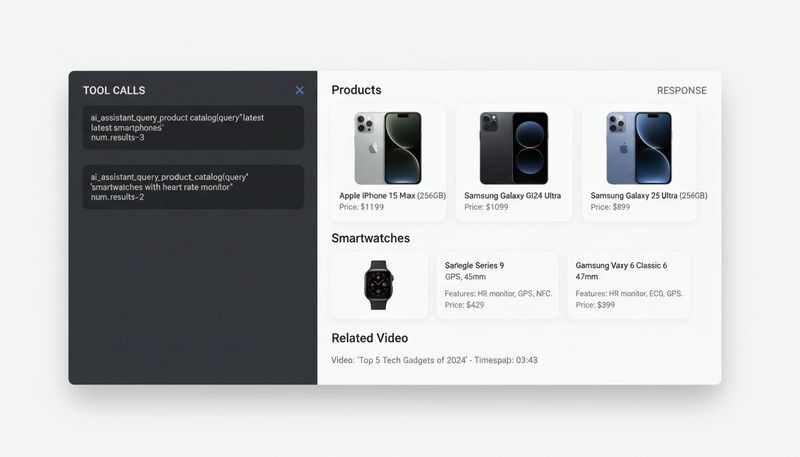
The next visitor to hit an ecommerce product API may not be a person at all. Since OpenAI, Google, and Microsoft adopted the model context protocol across their assistants in 2025, shopping agents inside ChatGPT, Gemini, and Copilot have started querying catalogs directly - searching, filtering, comparing, and in a growing number of cases checking out on a shopper's behalf. Shopify told investors on its Q3 2025 earnings call that AI-sourced traffic was up 7x and AI-attributed orders up 11x since January 2025. The mechanics behind that shift are specific and learnable: a single open protocol lets any agent call any system's tools without a custom integration for each pairing. Ecommerce teams that expose clean, structured search tools over MCP get discovered and recommended by agents. Teams that do not get scraped, summarized, and frequently skipped. This post covers how the protocol works, what an agent-ready catalog looks like in production, and what commerce and engineering teams should do about it this quarter.
What the Model Context Protocol Actually Is
Anthropic introduced the Model Context Protocol in November 2024 as an open standard for connecting AI systems to external tools and data. The design is deliberately boring. An MCP server exposes a set of typed tools - search this index, fetch this record, update this cart - and any MCP-compatible client can discover and call them. The client might be Claude, ChatGPT, Gemini, or a homegrown agent. The server does not care.
That indifference is the point. Before MCP, wiring five assistants to five backend systems meant twenty-five custom connectors, each with its own auth quirks and payload formats. With MCP, each system ships one server and each assistant ships one client. The integration math drops from N times M to N plus M.
The industry noticed fast. OpenAI adopted MCP across its Agents SDK, Responses API, and ChatGPT desktop in March 2025. Google DeepMind confirmed Gemini support that April. By December 9, 2025, when Anthropic donated the protocol to the Agentic AI Foundation - a Linux Foundation directed fund co-founded by Anthropic, Block, and OpenAI, with support from Google, Microsoft, AWS, Cloudflare, and Bloomberg - Anthropic counted more than 10,000 active public MCP servers and 97 million monthly SDK downloads across Python and TypeScript. The protocol had become neutral industry infrastructure rather than one vendor's spec.
Growth has not slowed since. The official MCP Registry grew 407 percent to nearly 2,000 entries within about two months of its September 2025 launch, per the protocol team's anniversary retrospective, and an independent Nerq census in early 2026 indexed 17,468 servers across registries. The November 2025 spec release added task-based asynchronous workflows and OAuth client credentials for machine-to-machine authorization - exactly the plumbing that long-running commerce operations need. Specifications and SDKs live at modelcontextprotocol.io.
How Agents Use MCP to Search Across Systems
A single tool call is table stakes. The interesting behavior appears when agents chain tools across systems to answer questions no single index can.
Observability offers the clearest production example. OpenSearch ships a built-in MCP server starting in version 2.19, with no separate deployment required, and its work on agentic search in OpenSearch shows agents performing root-cause analysis by chaining tools such as LogPatternAnalysisTool, MetricChangeAnalysisTool, and DataDistributionTool - correlating logs, traces, and metrics that previously required an engineer to join across three dashboards by hand.
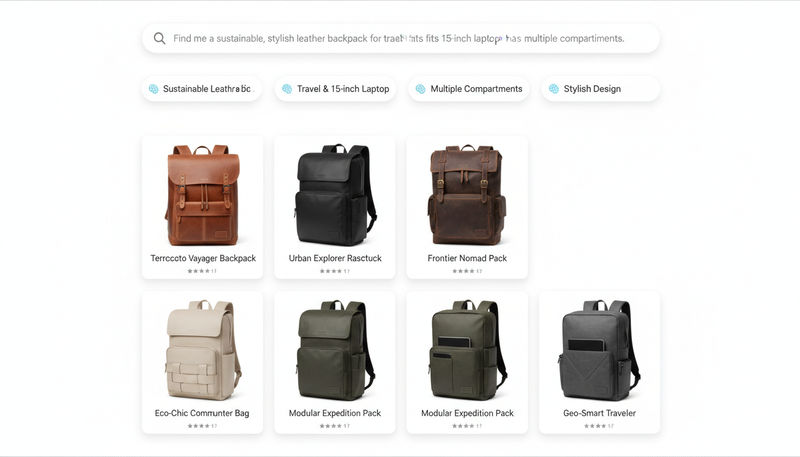
Translate that pattern to commerce. A shopper asks an agent for a trail running shoe in size 11, under $120, that ships before Friday. The agent calls a catalog search tool with structured filters, cross-references an inventory tool for real-time stock near the buyer's zip code, pulls the returns window from a policy tool, and only then presents two candidates with delivery dates. Four systems, one conversation, zero page views.
Cross-system correlation of this kind rewards a specific style of API design. Each tool must return structured, self-describing results the model can reason over. A search response of ranked products with typed attributes - price, size availability, delivery estimate, review score - lets the agent filter, compare, and justify a recommendation to the shopper. A blob of rendered HTML does not. Teams that built API-first search and discovery are, partly by accident, already halfway to agent-ready. Teams whose search only exists as a front-end widget have a rendering layer where their interface should be.
What an MCP-Ready Product Catalog Looks Like
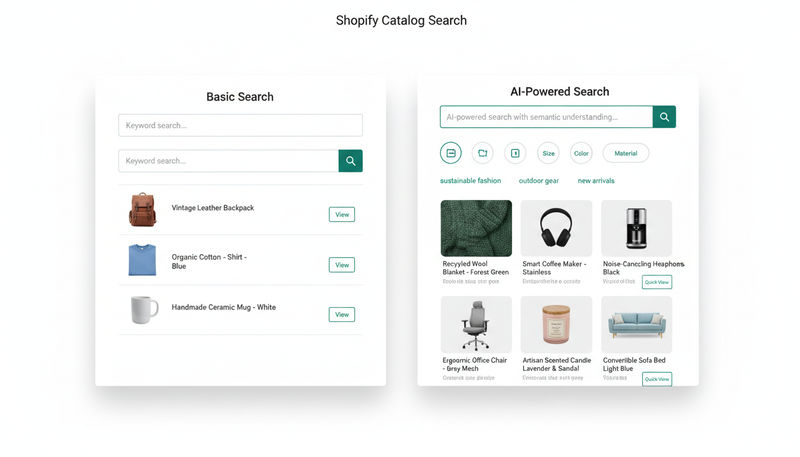
Shopify's Storefront MCP server is the clearest template running in production today. Every eligible storefront exposes an unauthenticated MCP endpoint at a predictable path (/api/mcp on the shop's own domain), and any agent that speaks the protocol can call a compact set of tools:
- search_catalog: natural language query with filtering and pagination
- lookup_catalog: batch retrieval of up to 10 product IDs
- get_product: full structured detail for a single item
- get_cart and update_cart: cart state an agent can build toward checkout
- search_shop_policies_and_faqs: shipping, returns, and warranty answers
Study the list and a pattern emerges. This is a discovery API, not a data dump. The agent never downloads the catalog; it searches, narrows, verifies, and acts - the same loop a human shopper runs, at machine speed and without the patience for a bad results page.
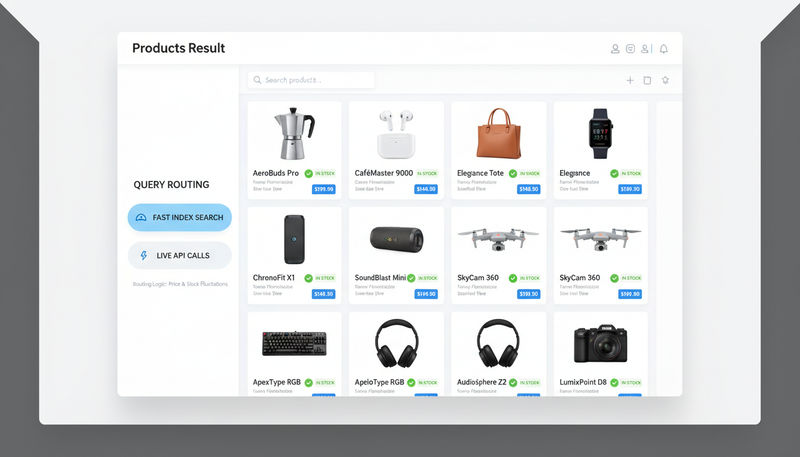
The quality bar therefore moves to the search layer underneath. If search_catalog returns weak relevance for "waterproof hiking boots women's 8", the agent presents weak candidates or moves on to a competitor's server. If inventory data lags by an hour, the agent recommends a 40,000-SKU retailer's one out-of-stock item, and the shopper blames the assistant once and the store permanently. Structured attributes, faceted filtering, semantic relevance, and real-time availability stop being conversion optimizations. They become the entire substance of what agents see.
That is where an API-first stack earns its keep. A unified discovery platform like Seekora already returns typed, filterable responses from its search, browse, and recommendation endpoints, which makes expressing them as model context protocol tool definitions thin work rather than a replatforming project.
The Multimodal Turn: Video, Images, and Full-Page Extraction
When no structured tool interface exists, agents do not give up. They read.
Firecrawl's search endpoint illustrates the fallback pattern: one call returns ranked results plus the full markdown content of every page rather than 150-character snippets, and the company ships it as an MCP server alongside its REST API and SDKs. An agent hitting a store without catalog tools scrapes the product page into markdown, guesses which string is the price, and hopes the size chart survived the conversion. Sometimes that works. It remains strictly worse than a typed get_product response, and the merchant has no control over what the extraction misses or mangles.
Video is following the same arc. TwelveLabs exposes video understanding as MCP tools - indexing, semantic search, analysis, embeddings - callable from Claude Desktop, Cursor, and Windsurf. The company says its Marengo model embeds visual frames, audio, and transcription in one shared latent space with segment-level timestamps, so an agent can retrieve the exact second in a 12-minute review video where a jacket's zipper gets tested in the rain. Academic work points the same way: V-Agent, a multi-agent video search system published on arXiv, independently embeds frames and speech transcripts into a shared multimodal space and lets routing, search, and chat agents collaborate to refine results.
For commerce catalogs the implication is direct. Product demo videos, unboxing footage, lifestyle imagery, and customer clips are becoming retrievable evidence rather than decoration. An agent asked whether a stroller folds one-handed can, in principle, cite the timestamp where it happens. Catalogs that attach rich media to structured product records give agents more to reason with - and more reasons to recommend.
How Commerce Teams Should Prepare
The commercial rails are already live. OpenAI and Stripe launched the Agentic Commerce Protocol with Instant Checkout in ChatGPT on September 29, 2025, starting with US Etsy sellers and extending to over a million Shopify merchants, with each merchant remaining the merchant of record. Shopify answered in January 2026 with the Universal Commerce Protocol, an open standard layered over MCP that the company says 20-plus retailers and platforms endorsed at launch, putting merchants inside Google AI Mode, the Gemini app, Microsoft Copilot with embedded checkout, and ChatGPT. Winter '26 rollout coverage reports that Shopify's Agentic Storefronts went live by default for eligible US merchants in March 2026, making roughly 5.6 million stores automatically discoverable to agents. The 7x traffic and 11x order figures Shopify reported suggest that this kind of discovery converts.
Preparation splits into two workstreams, and neither requires guessing which assistant wins.
- Expose search over the model context protocol. Wrap existing search and product APIs in MCP tool definitions with precise names, typed parameters, and honest descriptions. Tool descriptions are the new meta tags: agents read them to decide which tool to call and what to pass it.
- Fix structured data hygiene. Normalize sizes and variants, complete attribute coverage, keep pricing and inventory real-time, and make shipping, returns, and warranty policies queryable rather than buried in a PDF.
The second workstream is the harder one, and it compounds. A catalog with clean, typed attributes improves human-facing search today and feeds every agent tomorrow. One well-built catalog server then serves ChatGPT, Gemini, Copilot, and Claude alike, the same way one well-formed sitemap once served every crawler.
The Bottom Line for Ecommerce Teams
Eighteen months took the model context protocol from an Anthropic experiment to Linux Foundation-governed infrastructure with cross-vendor adoption from OpenAI, Google, and Microsoft, thousands of public servers, and commerce deployments spanning millions of storefronts. Agents are already searching catalogs. The open question is what they find: a structured, well-described search tool that returns typed products and honest inventory, or a pile of HTML to scrape and misread.
The playbook is short. Get product data structured and current. Make search relevance excellent, because relevance is now the product agents evaluate before a shopper ever sees a page. Then expose that search over MCP so a single integration covers every assistant a customer might bring. Measure agent traffic separately as it grows, because it will not show up in session analytics built for browsers.
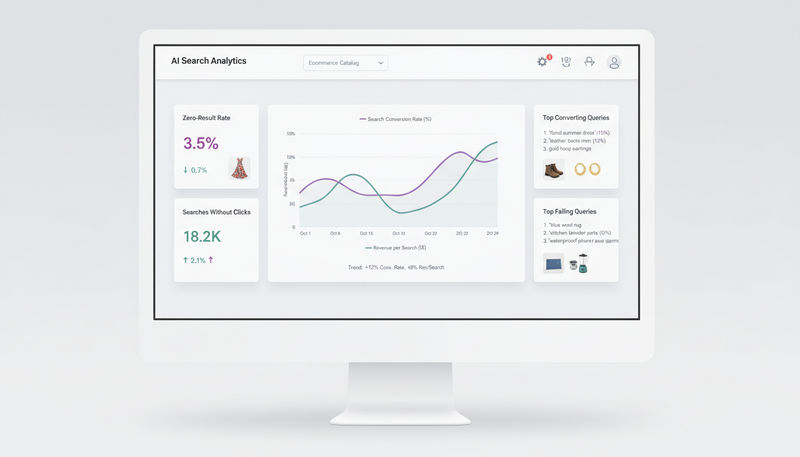
Seekora builds exactly this layer: AI-powered search, browse, recommendations, and personalization delivered through APIs designed to map cleanly onto MCP tool definitions, with analytics that show what agents actually query. Teams ready to make their catalog callable can start with Seekora's MCP developer documentation, stand up a catalog server, and put their products in front of agent traffic before the next quarterly report makes the case for them.
Model Context Protocol: How AI Agents Search Your Catalog
Top stories
Top stories
Stay ahead of the curve.
Subscribe to get the latest e-commerce insights and AI strategies delivered directly to your inbox.