
Shopify Search & Discovery vs AI Search: When to Upgrade
By Seekora Editor
May 27, 2026
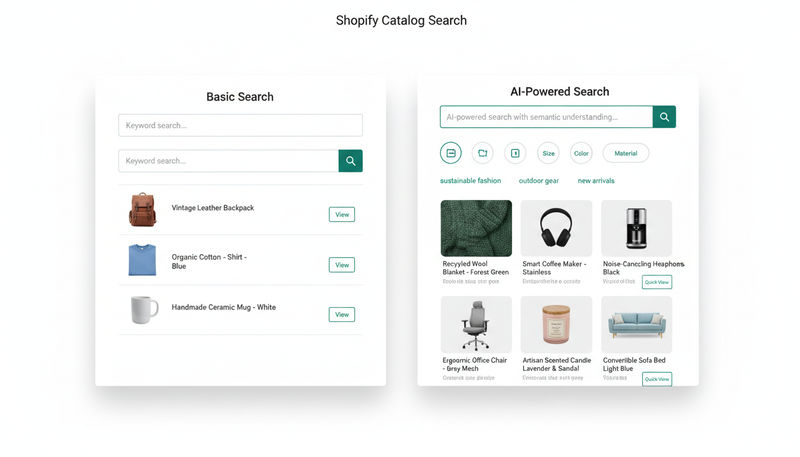
Shopify Search & Discovery is the default product discovery layer for millions of stores, and for small catalogs it does a respectable job. But as catalogs cross a few thousand SKUs and search becomes a high-intent traffic source, the gap between native search and AI-powered search starts to widen. Shoppers who type into the search bar convert at far higher rates than those who browse, which means every zero-result query, every typo, and every missed synonym is leaked revenue. The question is no longer whether AI search is real — it is whether the catalog has outgrown native tooling. This guide walks through what Shopify Search & Discovery does well, where it stops being enough, and how to decide if AI search is the right next move.
Why Shopify Search Matters More as Your Catalog Grows
Site search users are not casual visitors. They have a query in mind, they typed it on purpose, and they are signaling exactly what they want to buy. Industry studies consistently show that search users convert two to five times higher than non-search visitors and contribute an outsized share of revenue.
That dynamic flips as the catalog grows. With 500 SKUs, almost any search returns something reasonable. With 50,000 SKUs across variants, colors, sizes, materials, and brand pages, ranking quality becomes the difference between a sale and a bounce. A small mismatch in how the search engine interprets "linen shirt under 2000" stops being a UX detail and starts being a revenue problem.
This is why merchants who scale eventually outgrow native search — not because Shopify is bad, but because their search traffic has become too valuable to leave to defaults.
What Shopify Search & Discovery Does Well
Shopify Search & Discovery is a free first-party app that ships meaningful relevance controls without code. For a large segment of stores it is genuinely enough.
Key strengths:
- Synonyms. Merchants can declare that "sneakers" and "trainers" mean the same thing, so a query for one returns results for both.
- Product boosts. A merchandiser can promote specific products for specific search terms — useful for clearing stock, surfacing margin-rich items, or pushing new arrivals.
- Result-type settings. Stores can decide whether search returns products only, or also collections, pages, and articles.
- Out-of-stock handling. Sold-out products can be pushed down or hidden so customers do not waste clicks.
- Semantic search. Shopify rolled out semantic understanding for stores under a certain catalog size and plan tier — it interprets meaning, not just keywords, on the main search results page.
For a Shopify store with a focused catalog, clean product data, a handful of synonym rules, and limited merchandising needs, Search & Discovery covers the basics and ships with the platform.
Where Native Shopify Search Becomes Limiting
The limits show up in predictable patterns. The most common upgrade signals:
- Catalog size. Semantic search in Shopify Search & Discovery is gated by product count and plan tier. Stores beyond that threshold lose semantic ranking on exactly the queries where it matters most.
- Predictive search. The instant-suggest dropdown does not benefit from semantic understanding the way the full results page does, which leaves the most visible search surface running on older relevance signals.
- Personalization. Native search ranks the same results for every shopper. A first-time visitor and a repeat buyer with a clear style preference see identical product orders.
- Merchandising depth. Pinning a product to a single query is easy. Building rules per category, per audience segment, per campaign, or per device is not.
- Search analytics. Shopify shows top searches and no-result terms, but stitching that into revenue, conversion, click position, and search abandonment requires patching together exports.
- Typo and synonym complexity. Every misspelling, abbreviation, regional spelling, and informal product name has to be declared by hand. At scale, that list is unmaintainable.
- Multi-storefront and B2B catalogs. Stores running multiple markets, languages, or a B2B price-list catalog need ranking logic that respects entitlements, contract pricing, and SKU/model hierarchies — not just generic relevance.
If two or three of these patterns sound familiar, the catalog has likely outgrown what native Shopify search was designed for.
What AI Search Adds Beyond Native Shopify Search
AI search apps replace keyword-and-rules pipelines with neural ranking models that understand language and behavior. The practical additions:
- Neural relevance. Vector embeddings let the engine match products by meaning, so "running shoes for flat feet" surfaces the right stability sneakers even when the product description never uses the exact phrase.
- Typo tolerance and fuzzy matching. Misspellings, plural/singular forms, and partial words resolve to the correct products without manual synonym entry.
- Natural language queries. Shoppers can type "birthday gift for a coffee lover under 3000" and the engine extracts intent, price range, and use case.
- Personalized ranking. Results reorder based on past sessions, recent views, and behavioral signals — without a separate personalization tool bolted on.
- Recommendations and dynamic filters. Related products, frequently bought together, and category-aware filter facets render alongside the search experience instead of as a separate app.
- Zero-result reduction. When no exact match exists, AI search expands to semantically similar items rather than returning an empty page.
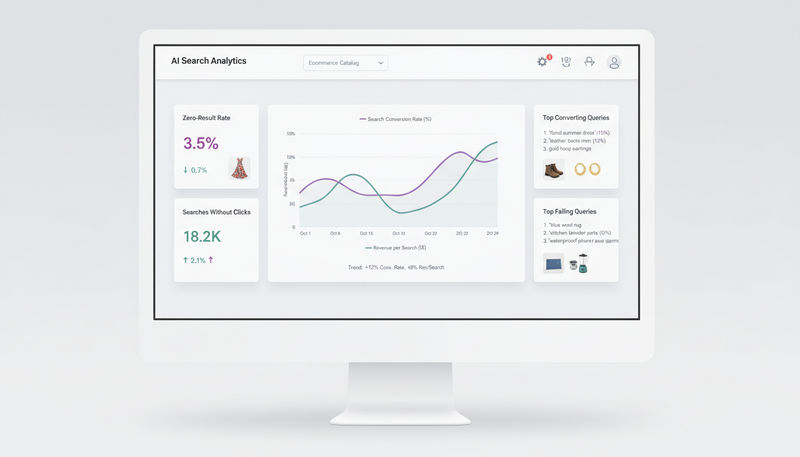
- Unified analytics. Search performance, no-result queries, conversion contribution, and revenue per search land in one dashboard tied to ranking changes.
This is the gap AI search for ecommerce closes — replacing rule maintenance with models that adapt as the catalog and shopper base evolve.
Stay Native or Upgrade? A Decision Framework
Not every store needs AI search. The decision is mostly about catalog complexity, search traffic volume, and how much revenue depends on getting search right.
| Stay with Shopify Search & Discovery if… | Upgrade to AI search if… |
|---|---|
| Catalog is under 2,000 SKUs with stable attributes | Catalog exceeds 5,000 SKUs or has heavy variants |
| Synonyms and product boosts cover the bulk of relevance issues | The synonym list is growing weekly and still missing queries |
| Search drives a small share of overall sessions | Search drives 15% or more of sessions and a higher share of revenue |
| Zero-result rate is low and concentrated on long-tail typos | Zero-result rate exceeds 8–10% across head and torso queries |
| Personalization is not a near-term priority | First-time vs returning visitors should see different rankings |
| Merchandising rules are simple and global | Rules need to be category-specific, segment-specific, or seasonal |
| Analytics needs are met by top-searches reports | Teams need search-revenue attribution, query funnels, and A/B testing |
| Store runs one storefront on one plan | Multi-region, multi-language, or B2B with contract pricing |
If three or more rows tilt toward upgrade, the ROI math for an AI search app usually works.
Examples by Store Type
Fashion. Variant-heavy catalogs (size, color, fit, season) overwhelm rule-based search fast. Queries like "oversized linen shirt" or "midi dress for petite" need semantic understanding, not synonym tables.
Beauty. Shoppers search by skin concern, ingredient, finish, and routine step — "vitamin C serum for sensitive skin". Native search misses the intent unless every product description carries those exact phrases. AI search infers them.
Electronics. Model numbers, compatibility, and specs dominate. A query for "laptop bag for 16 inch macbook" needs to match dimensions and use case, not just product titles. Precision-based product matching is a non-negotiable.
Home goods. Style, room, and material drive intent ("mid-century walnut console table"). Personalized ranking based on past browsing pays off heavily here because category browse is dispersed across thousands of SKUs.
B2B wholesale. Buyers search by SKU, model number, part code, and contract-priced item. Search has to respect entitlement (which buyer sees which catalog) and return exact matches first. Native Shopify search was not designed for this — AI search platforms with B2B-aware ranking are.
Implementation Checklist Before You Upgrade
Moving to AI search is not just an app install. Get these in order first so the upgrade actually pays off:
- Product data quality. Every SKU needs structured attributes (size, color, material, use case, gender, age, brand). AI search ranks on this data — garbage in, garbage out.
- Synonyms and brand vocabulary. Pull the existing synonym list from Search & Discovery as a starting point. Most AI search engines learn additional ones automatically but still benefit from the seed.
- Faceted filters. Decide which attributes become filters on the storefront. AI search platforms generally auto-suggest dynamic filters, but a baseline list helps.
- SKU and model matching. For electronics or B2B, ensure model numbers and SKU codes live in indexable fields, not buried in description HTML.
- Analytics setup. Connect search events to conversion tracking so revenue attribution works on day one. Tracking zero-result and no-click queries is what makes the upgrade visible.
- A/B testing plan. Roll out AI search to a subset of traffic first. Compare conversion rate from search, revenue per search session, and zero-result rate against the native baseline.
- Sandbox first. Most platforms — including Seekora's ecommerce search stack — let merchants test on a staging catalog before flipping live traffic.
FAQs About Shopify Search & Discovery vs AI Search
Is Shopify Search & Discovery free?
Yes. It is a first-party app maintained by Shopify and available to all stores. Semantic search inside it has eligibility requirements based on catalog size and plan tier.
When should a Shopify merchant consider an AI search app?
When the catalog exceeds a few thousand SKUs, when search drives a meaningful share of revenue, when zero-result rate climbs above 8–10%, or when personalization and merchandising rules become hard to maintain in native settings.
Does AI search replace Shopify Search & Discovery completely?
Most AI search apps replace the search bar, predictive dropdown, search results page, and category browse. Shopify Search & Discovery can usually be left installed but stops being the active search engine.
What is the biggest risk of upgrading?
Migrating without clean product data. AI search exposes data gaps that rule-based search papered over. Cleaning attributes before launch avoids ranking surprises.
Can AI search improve mobile search performance?
Yes. Mobile shoppers type shorter, error-prone queries and abandon faster. Typo tolerance, semantic matching, and personalized ranking lift mobile conversion measurably.
Will AI search hurt SEO?
No — search apps run on the storefront and do not change indexable URLs. Storefront category and product pages remain canonical for SEO purposes.
Wrapping Up: How Seekora Helps Shopify Stores Outgrow Native Search
Shopify Search & Discovery is a strong default. It only becomes a problem when the catalog, the traffic, and the revenue mix outgrow what synonyms and boosts can hold together. The signals — large SKU counts, semantic search gaps, zero-result drag, personalization needs, complex merchandising, B2B catalogs — are the same across every vertical.
This is exactly where Seekora helps. The platform plugs into Shopify (and WooCommerce) to deliver neural search, typo tolerance, natural language understanding, personalized ranking, dynamic filters, recommendations, and zero-result reduction — backed by analytics that tie every query to revenue. Merchants get a sandbox to A/B test against their existing Search & Discovery setup before any traffic flips, so the upgrade decision is grounded in conversion numbers, not hopes. If the upgrade signals in this guide match the store, start with a side-by-side test on Seekora and let the data make the call.
Shopify Search & Discovery vs AI Search: When to Upgrade
- Why Shopify Search Matters More as Your Catalog Grows
- What Shopify Search & Discovery Does Well
- Where Native Shopify Search Becomes Limiting
- What AI Search Adds Beyond Native Shopify Search
- Stay Native or Upgrade? A Decision Framework
- Examples by Store Type
- Implementation Checklist Before You Upgrade
- FAQs About Shopify Search & Discovery vs AI Search
- Is Shopify Search & Discovery free?
- When should a Shopify merchant consider an AI search app?
- Does AI search replace Shopify Search & Discovery completely?
- What is the biggest risk of upgrading?
- Can AI search improve mobile search performance?
- Will AI search hurt SEO?
- Wrapping Up: How Seekora Helps Shopify Stores Outgrow Native Search
Top stories
Top stories
Stay ahead of the curve.
Subscribe to get the latest e-commerce insights and AI strategies delivered directly to your inbox.