
LLMs vs Generative AI: What's the Difference and Why It Matters
By Seekora Editor
May 17, 2026
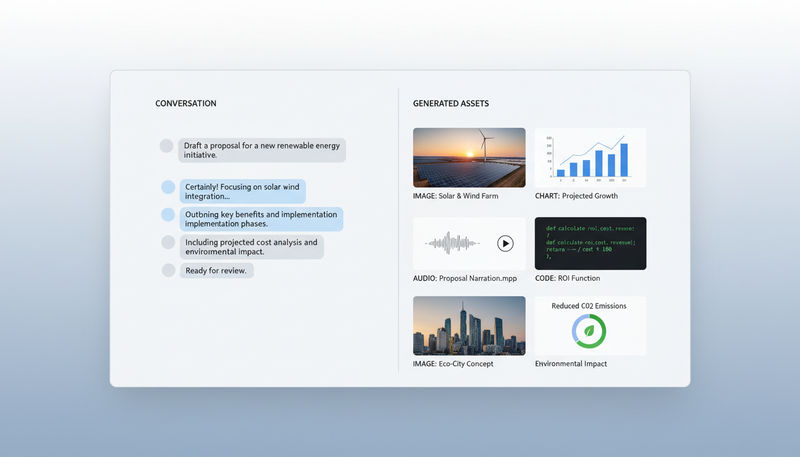
Walk into any commerce platform conversation in 2026 and the two phrases get used as if they meant the same thing: the team is adding an LLM or the team is adding generative AI. Half the time the speaker means the same model. Half the time they mean different parts of the same pipeline. And almost always, the listener nods along while quietly making different assumptions about scope, cost, and capability.
The confusion is not academic. It shapes how teams scope projects, write contracts with vendors, design fallbacks, and forecast infrastructure cost. So before another roadmap gets approved on muddled terminology, it is worth pinning down what each term actually means, where they overlap, and which one the discovery layer of a commerce platform genuinely needs.
Why the confusion matters more than it looks
When LLMs and generative AI get conflated, three concrete things go wrong on commerce projects.
Scope assumptions drift. A team scoping a "generative AI shopping assistant" may quietly assume the system needs to produce original imagery and product copy on demand, when the actual requirement is conversational query understanding — a much smaller, cheaper problem. Or the opposite happens: a team scopes an "LLM-powered search" expecting it to generate personalized product descriptions and discovers two months in that the model they picked was never trained for content generation at scale.
Cost projections get fragile. Generative output (image, structured content) has very different latency and per-call economics from a conversational text response. Confusing the two leads to budget surprises in week six of an implementation.
Fallback design suffers. A robust commerce stack needs to know which calls can degrade gracefully to a deterministic fallback (a category search, a static merchandised list) and which calls are essentially decorative. That mapping is impossible without clean vocabulary.

Generative AI: producing content from a prompt
Generative AI is the broad family of models whose primary job is to produce new content — images, music, video, structured data, and yes, text — conditioned on a prompt or input context.
The defining property is the output modality space. A generative AI system can be a diffusion model that produces product photography, a music generator that scores a brand video, a code synthesizer that drafts a Shopify theme component, or a text generator that drafts a product description. The shared thread is that the model is producing something the catalog did not already contain.
For commerce platforms, the genuine generative AI use cases are narrower than vendor marketing suggests. The realistic ones are: drafting first-pass product descriptions from a structured attribute feed, generating localized product copy at scale, producing on-brand lifestyle imagery for unphotographed long-tail SKUs, and synthesizing personalized email or onsite copy. Each of these has measurable ROI, but each also has a real failure mode (hallucinated specifications, off-brand voice, image inconsistency) that needs human review or strict guardrails.
The wrong place to put a generative AI call is in the hot path of every search request. Generating output per query blows up latency, blows up unit cost, and almost always degrades the result quality compared to retrieval over a well-prepared catalog.
LLMs: understanding language and managing context
Large language models — LLMs — are a subset of generative AI specialized for language understanding and language production. They are the part of the family that has the best mileage on text-in, text-out tasks.
The defining property of an LLM, at least for commerce purposes, is not that it generates text but that it carries contextual understanding across a long stretch of input. A modern LLM can take a multi-turn shopper conversation, a structured catalog snippet, and a set of business rules, and produce a grounded answer that respects all three. That is the genuinely new capability — not the generation per se, but the consistent reasoning across messy context.
In a discovery stack, the LLM's role is rarely "replace the search engine". The high-leverage placements are: interpreting natural-language queries into structured intent before retrieval; explaining results to agent traffic in machine-readable format; handling the conversational refinement loop ("lean toward the coffee gear") without losing the earlier turns; and acting as a tiebreaker on ambiguous queries where lexical and vector retrieval disagree.
Notice that none of these involve the LLM generating product content. Most production discovery stacks use LLMs as a reasoning layer over retrieval, not as the content engine.
LLMs vs generative AI: where they overlap (and where they diverge)
Every LLM is generative AI; not every generative AI system is an LLM. Three practical distinctions matter.
Output modality. Generative AI spans image, audio, video, structured data, and text. LLMs are text-first, with multimodal extensions appearing but still trailing the dedicated image and audio models on quality.
Latency and cost profile. Generative image and video models are typically slow and expensive per call. LLMs handling conversational text are fast and relatively cheap. Knowing which one a feature needs determines whether it can live in the hot path or has to be precomputed.
Failure mode. Generative AI fails by hallucinating content that does not exist (a product with wrong specs, an image that looks like a real product but is not). LLMs fail by losing context across long conversations or by missing constraints buried in business rules. The mitigations are different: generative AI needs validation against ground-truth data; LLMs need careful prompt structuring and structured outputs.
When commerce teams need which
A practical decision rule, road-tested across discovery, merchandising, and content teams:
If the feature understands what the shopper said — search, conversational refinement, agent query parsing, intent classification, query rewriting — you need an LLM in the reasoning layer. The catalog content is already produced; the LLM's job is to navigate it.
If the feature produces content that did not exist before — first-pass descriptions, localized variants, on-demand imagery, personalized email copy — you need generative AI in a content pipeline. The pipeline runs offline or asynchronously, with review queues for high-risk outputs.
If the feature does both — for example, a conversational shopping assistant that summarizes a curated list of results in natural-language prose — you need both, composed carefully. The LLM handles the conversational state and reasoning; a small templating or generative step produces the natural-language summary; retrieval grounds everything in real catalog data so the assistant cannot invent products that do not exist.
This last pattern — retrieval-grounded generation, often called RAG — is the architecture most modern discovery experiences settle on. It uses LLMs where they add real value (reasoning over context) and generative output sparingly (one short explanation per response, not a fresh product description per result). The full integration story for retailers building on this pattern is described in the seekora product overview and the developer quick-start.
Common pitfalls when teams scope these projects
Three pitfalls show up repeatedly in roadmaps that conflate LLMs and generative AI, and each one is avoidable with cleaner vocabulary up front.
The first is the every-call generation trap. A team excited about generative output wires the model into every search response, intending to produce a tailored summary per shopper. Within a week the cost dashboard lights up and the latency budget collapses. Production discovery stacks reserve generative calls for high-value or low-frequency surfaces — agent explanations, abandoned-cart emails, on-demand product imagery — not the hot retrieval path.
The second is the grounding gap. Teams deploy an LLM that sounds confident but is not anchored to live catalog data. It cheerfully invents specifications, sizes, and prices. The fix is retrieval-grounded generation: every model response is forced to cite real catalog entries, and any claim outside the retrieved context is either suppressed or flagged. Without this, the assistant becomes a liability rather than a feature.
The third is the evaluation vacuum. Generative output is harder to measure than retrieval relevance. Teams that ship without a structured evaluation suite — query-by-query, with human-rated samples — end up tuning on vibes. By the time a regression shows up in conversion data, the cause is buried under three model upgrades.
Wrapping up: which one drives revenue
The answer surprises most teams the first time they hear it. In a commerce discovery context, LLMs drive more revenue than generative AI does — by a wide margin and a fast payback. Better query understanding lifts conversion immediately. Smarter conversational refinement lowers bounce rate. Agent-readable grounded responses unlock the fastest-growing slice of traffic.
Generative AI in commerce earns its keep on the long tail — generating description quality across thousands of unphotographed SKUs, scaling localized content, and producing on-brand imagery for catalogs that could not previously afford it. These wins compound over months, not weeks.
The practical mistake is treating the two terms as one budget line. They are different cost centers, different risk profiles, different review processes. Teams that separate them in planning ship more confidently and avoid the late-stage surprises that have killed many otherwise-promising AI commerce projects.
The one-sentence version: use LLMs where the system needs to understand, use generative AI where the system needs to produce, and never confuse the two in a roadmap document again.
LLMs vs Generative AI: What's the Difference and Why It Matters
- Why the confusion matters more than it looks
- Generative AI: producing content from a prompt
- LLMs: understanding language and managing context
- LLMs vs generative AI: where they overlap (and where they diverge)
- When commerce teams need which
- Common pitfalls when teams scope these projects
- Wrapping up: which one drives revenue
Top stories




Top stories
Stay ahead of the curve.
Subscribe to get the latest e-commerce insights and AI strategies delivered directly to your inbox.