
AI Search for Ecommerce: Reshaping the Modern Customer Experience
By Seekora Editor
May 17, 2026
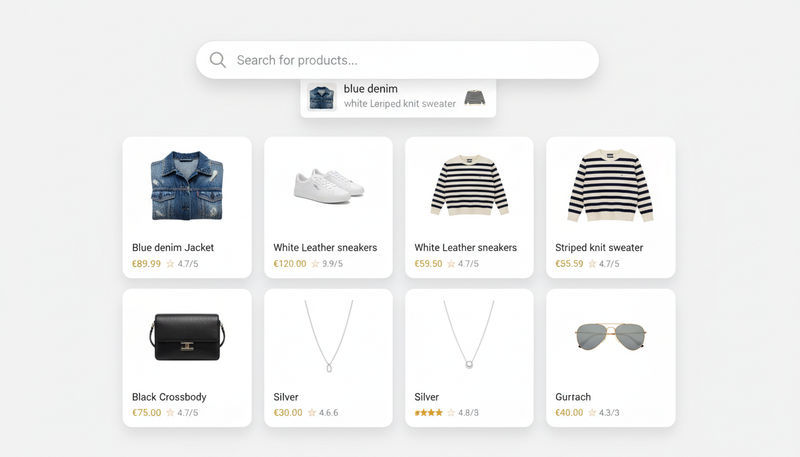
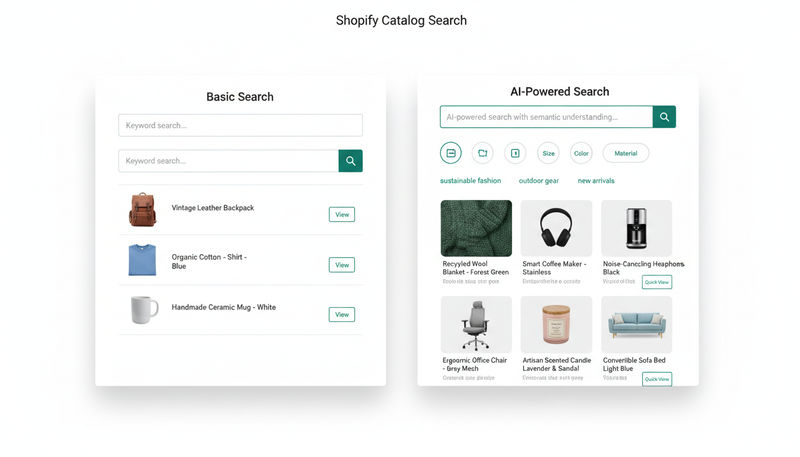
Most ecommerce sites today are still running discovery experiences built around a 2015 assumption: shoppers will type two or three keywords, scan a results page, click a faceted filter or two, and bounce if they don't find what they want in the first ten cards. That assumption powered a decade of solid revenue. It is also the assumption AI shoppers no longer make.
A different ecommerce experience is now technically possible — one where the customer expresses intent in their own words, the catalog actually understands it, and the journey from query to checkout collapses from minutes to seconds. This piece walks through what AI search for ecommerce changes, where the gap shows up first, and what retailers can do before agent-driven traffic widens that gap into a permanent moat for early movers.
Why the legacy ecommerce playbook is running out of room
For a decade, the dominant pattern was: index every SKU into a keyword search engine, layer filters on top, bolt a recommendation widget on the product page, and call the result a discovery experience. Conversion teams optimized the funnel one stage at a time — search relevance here, filter UX there, recommendation algorithm somewhere else — and each stage was owned by a different team with a different definition of success.
That model has three exhaustion points.
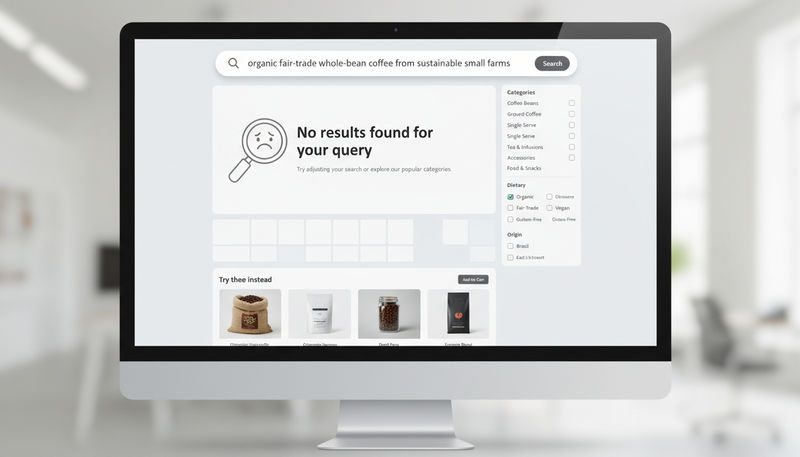
First, queries are getting longer and messier. A shopper looking for "a lightweight running jacket that handles light rain but still breathes for high-intensity workouts" is doing something a TF-IDF index has no language for. Classical search either returns generic jackets or nothing useful.
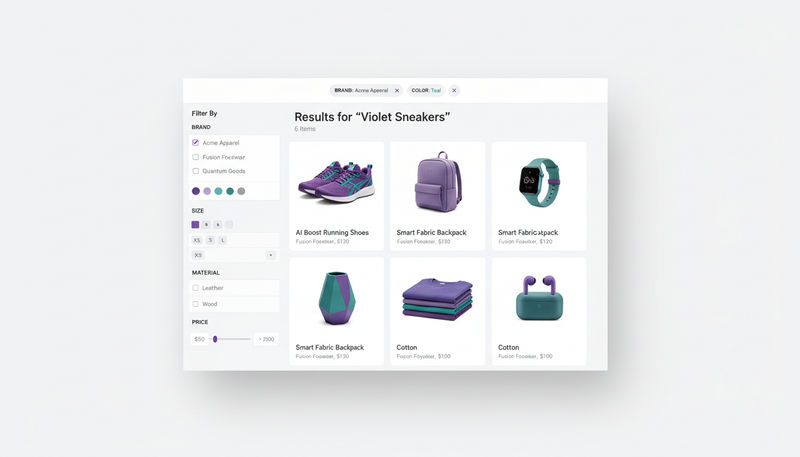
Second, shoppers refuse to learn the catalog's taxonomy. They will not click "Outerwear > Performance > Rain Resistant". They expect the catalog to do that mapping. Every team that builds a faceted filter tree is implicitly betting that shoppers will adapt to it. They will not.
Third, the buyer is increasingly an agent. A customer's personal AI assistant arrives with structured intent, takes the top three results, and moves on. Most retailers have no visibility into this traffic because it does not look like a human browser. The legacy stack treats it as anomaly traffic at best.
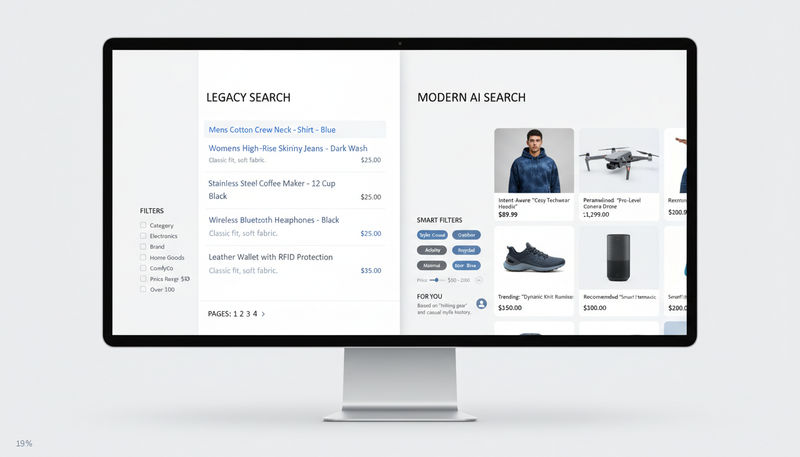
What "AI search for ecommerce" actually looks like
It is tempting to read "AI search" and think "chatbot on the homepage". That is the cheap interpretation, and it is the reason many AI search projects end up adding friction instead of removing it. Customers do not want two parallel discovery surfaces — a search bar and a chat widget — fighting each other for attention.
An AI-native ecommerce experience has four concrete properties:
- One semantic representation of the catalog. Every product is embedded into a vector space alongside its attributes, imagery, and behavioral signal. Whether the query arrives as text, image, voice, or a structured agent call, it resolves against the same representation.
- Intent resolved at the engine layer, not at the input. Natural-language phrasing, multi-clause queries, and visual references are all decomposed into the same internal intent representation. The shopper writes how they think; the catalog converts.
- One ranking contract. Business rules — margin priorities, inventory state, merchandiser boosts, personalization signals — are applied once, at the discovery layer, not re-implemented in each channel.
- One observability plane. Search, browse, recommendations, and agent calls all log against the same schema, so a single dashboard tells the team what is actually happening across every surface.
If any one of these is missing, the experience is not AI-native — it is keyword search with an LLM widget bolted on. Customers feel the difference, even when they cannot name it.
Three places the shopper journey changes first
AI search reshapes three specific moments in the customer experience, and these are the surfaces where retailers see ROI fastest.
Discovery. The search bar stops being a keyword box and becomes an intent interface. A query like "comfortable office shoes that work for both meetings and a quick walk to lunch" returns a curated set with relevance grounded in fit, materials, and review signal — not just whether "office" appears in the product title. Time-to-first-add-to-cart drops sharply because shoppers stop refining their own queries to match the engine.
Browse. Category pages are still useful, but the AI-native version personalizes layout, ranking, and filter prominence per shopper. A returning shopper who consistently filters by sustainable materials sees a different page from a first-time visitor with no signal. This is where retailers historically lose the most CRO budget — pixel-tuning a static page that does not adapt — and where AI-native browse pays for itself fastest.
Decision. Product detail pages get richer when the recommendation layer understands intent rather than only product co-views. "Customers who bought this also bought" gives way to "customers with your fit history found these alternatives more comfortable". The decision phase is where margin lives, and small lifts in cross-sell conversion compound through the rest of the funnel. The full surface is described in detail in the seekora recommendations product page.
The data underneath: catalog, signals, embeddings
AI-native discovery does not just need different ranking — it needs different data.
The catalog has to be enriched continuously: attribute normalization across suppliers, image embeddings, entity extraction (style, occasion, compatibility), and structured pricing/inventory metadata. A weekly batch is not enough. New SKUs and price changes need to flow into the semantic catalog within minutes, not days.
Signals have to extend beyond clicks. Dwell time, add-to-cart, abandoned-cart return-rate, agent acceptance, refund signal, and explicit feedback all feed the same store. The ranking model retrains on this signal frequently, and merchandisers get to see — for the first time, in many catalogs — what shoppers and agents are actually rewarding versus what merchandising thinks they should be.
Embeddings tie it all together. Once products live in a shared semantic space, multimodal search, cross-category recommendation, and agent-friendly structured retrieval all become natural rather than separate projects. Without that shared embedding layer, every new surface is another integration project. With it, surfaces compose.
What it costs to keep the legacy stack
It is easy to underestimate the carrying cost of a legacy ecommerce search stack because the costs are spread across teams and reporting lines.
Merchandisers spend disproportionate time tuning synonym lists, redirects, and category overrides — most of which an AI-native system handles implicitly. Engineering carries a search index, a recommendation engine, a visual search project, and a chatbot widget, each with their own deploy cadence and observability gap. Product owns conversion KPIs that depend on all four working together and rarely do.
Meanwhile, agent traffic is rising. The retailers who recognize this early are the ones whose catalogs become the preferred targets for autonomous shopping flows — low latency, structured answers, grounded responses. The retailers who wait become the fallback option, scraped when nothing better is available. The cost of waiting is not just slower growth; it is a slow handover of catalog visibility to whoever moved first.
The cost of doing nothing this quarter
Delaying the move to AI-native discovery is not a neutral choice. Every quarter the legacy stack stays in production, three costs accumulate quietly. The first is opportunity cost on the catalog itself — every query that returns a generic or empty result is a shopper who learned to expect less from this site than from the AI assistant they used last week. The second is engineering cost on a stack that was not built for multimodal or agent traffic; every patch and synonym list compounds the eventual migration. The third, and least visible, is competitive cost. The retailers who shipped AI-native discovery in the last two quarters are already reshaping shopper expectations across categories, and the bar for a credible ecommerce experience moves accordingly. Standing still is not the cheap option, even if it looks that way on a roadmap.
Wrapping up: where to start
The right move is not a big-bang search migration. It is a shadow-routing program: stand up a semantic catalog alongside the existing index, run live queries against both, and compare results offline for a few weeks. The data will tell the team where the legacy stack is leaking conversion. Once the team has trust in the new layer, migrate one surface at a time — typically site search first, then recommendations, then the conversational and agent-facing endpoints.
The broader product surface and integration story is laid out in the seekora product overview, and the engineering path for retailers building a semantic catalog is documented in the developer quick-start.
The takeaway is simple. The legacy ecommerce stack is not going to fail overnight, but it is going to keep getting more expensive to maintain, less attractive to agents, and less satisfying for the kind of shopper who has already learned to talk to AI assistants in plain language. Retailers who treat the shift as inevitable and start moving now will have an obvious advantage over those still betting on the 2015 funnel. Customers will notice; agents will notice faster.
AI Search for Ecommerce: Reshaping the Modern Customer Experience
- Why the legacy ecommerce playbook is running out of room
- What "AI search for ecommerce" actually looks like
- Three places the shopper journey changes first
- The data underneath: catalog, signals, embeddings
- What it costs to keep the legacy stack
- The cost of doing nothing this quarter
- Wrapping up: where to start

Stay ahead of the curve.
Subscribe to get the latest e-commerce insights and AI strategies delivered directly to your inbox.