
AI Shopping Agents in Ecommerce: Make Your Catalog Discoverable
By Seekora Editor
May 27, 2026
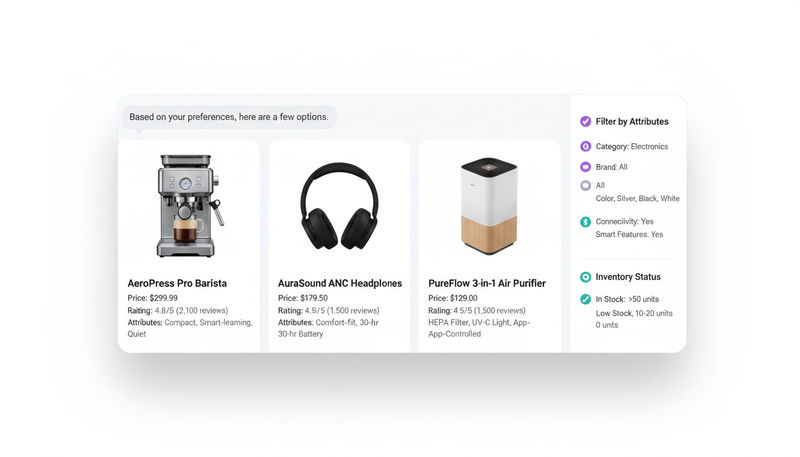
Ecommerce product discovery is moving beyond the search box. Shoppers are starting to type product intent into conversational AI surfaces — Gemini, Copilot, ChatGPT-style shopping, and emerging agentic checkout flows — and expect an answer that includes products, prices, availability, and policies, not just blue links. Google introduced the Universal Commerce Protocol (UCP) in early 2026 as an open standard for agentic commerce, designed to connect AI consumer surfaces with merchants and payment providers through APIs, A2A, and MCP. Shopify has parallel investments in Agentic Storefronts so merchants can define schemas, product groupings, policies, FAQs, and brand voice for AI agents to consume. The shift is not hype-worthy in itself — it is infrastructure. The merchants who get ahead are the ones whose catalogs are clean, structured, semantically searchable, and ready to be consumed by agents before the standards finish settling. This guide walks through what AI shopping agents actually do, what UCP and Agentic Storefronts signal, and the practical checklist to make an ecommerce catalog discoverable in the agentic era.
Why Ecommerce Discovery Is Moving Beyond the Search Box
For most of the last two decades, the dominant ecommerce discovery loop was: type a query into Google, scan ten blue links, click a category page, filter, click a product, compare, buy. AI shopping agents collapse most of that into one conversational turn. The shopper describes intent in natural language — "find me a waterproof jacket under five thousand for trekking" — and the agent does the searching, filtering, comparing, and shortlisting on their behalf.
That shift changes which catalogs surface and which do not. Agents do not read marketing pages; they read structured product data, specs, attributes, availability, and policies. A catalog with rich, machine-readable attributes shows up in the answer. A catalog with thin titles, sparse descriptions, and inconsistent data sits out the conversation. Discoverability becomes an infrastructure problem, not a creative one.
This is why the right framing is readiness, not adoption. The standards (UCP, MCP, A2A) and platforms (Gemini, Copilot, agentic checkout, Shopify's storefronts) will keep evolving, but the underlying requirements for being discoverable are already clear and stable.
What AI Shopping Agents Actually Do
An AI shopping agent is, at its simplest, a conversational system that helps a shopper discover, compare, and buy products without manual searching and browsing. It accepts natural-language intent, queries one or more commerce data sources, ranks candidates against the shopper's stated and implied preferences, and presents a shortlist (often with rationale).
The behaviors that matter for merchants:
- Intent extraction. The agent decomposes the query into structured criteria — category, attribute filters, price range, use case, recipient, occasion, and inferred preferences.
- Catalog query. The agent calls a search or recommendation API, or reads structured product data, to retrieve candidates.
- Comparison and ranking. The agent ranks candidates against the criteria and the shopper's history, surfacing tradeoffs (price, features, ratings, availability).
- Action. Increasingly, the agent can add to cart, check out, and even pay through standards like UCP — without bouncing the shopper to a separate site.
A catalog whose data, search, and APIs satisfy each of those stages becomes a viable answer in agent-driven discovery. One that does not, does not.
What UCP and Agentic Storefronts Signal for Ecommerce
Two recent developments make the shift concrete.
Universal Commerce Protocol (UCP). Google introduced UCP in January 2026 as an open-source standard for connecting AI consumer surfaces (chat assistants, agents), businesses, and payment providers. It is designed to slot into existing retail infrastructure through APIs, agent-to-agent (A2A) communication, and the Model Context Protocol (MCP). The signal: discovery and checkout will increasingly happen inside agent surfaces, with merchants integrating through standardized endpoints rather than custom one-off integrations per AI platform.
Shopify Agentic Storefronts. Shopify has co-developed UCP with Google and announced Agentic Storefronts, a layer that lets merchants get discovered on AI platforms and define schemas, product groupings, policies, FAQs, and brand voice — so agents can present products accurately rather than guessing or hallucinating attributes.
The pattern is consistent: AI surfaces need structured, machine-readable data from the merchant side. Catalog quality, search relevance, recommendation APIs, and clear policy data become the inputs. Catalog readiness today is what determines whether a brand surfaces in agent-driven shopping a year from now.
Catalog Readiness Checklist for AI Agents
The single highest-leverage action a merchant can take is making product data complete, consistent, and machine-readable. The checklist:
- Product titles. Clear, structured, and specification-rich. "Men's Waterproof Trekking Jacket — Navy — Size L" beats "Adventure Jacket - Style 47".
- Descriptions. Cover what the product is, who it is for, what it solves, and where to use it. Agents extract intent from this copy.
- Attributes. Every SKU needs structured attributes: material, size, color, gender, use case, occasion, age group, dimensions. Strings buried in HTML do not count.
- Variants. Color and size variants must roll up to a single parent product with explicit options. Disconnected variant pages confuse agents.
- Pricing. Current price, original price, and any promotions exposed in structured fields.
- Inventory. Real-time stock state per variant. Agents avoid recommending out-of-stock items.
- Return and shipping policies. Machine-readable policies — return window, shipping options, lead times — increase trust and conversion in agent flows.
- Reviews and ratings. Aggregate score, count, and breakdown. Agents use these as ranking signals.
- FAQs. Structured FAQ data per product or category. Agents lean heavily on FAQs to handle clarifying questions.
- Use-case tags. Beyond category, tag products by use case ("trekking", "office", "gifting", "weekend casual"). Agents map shopper intent to these.
- Images and alt text. Multiple angles, lifestyle shots, and descriptive alt text. Multi-modal agents use images alongside text.
- Structured data. Schema.org Product, Offer, AggregateRating, and Review markup on every product detail page.
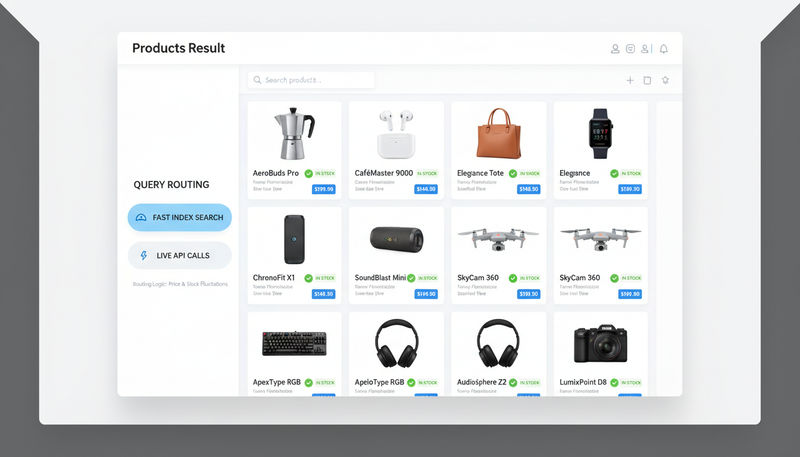
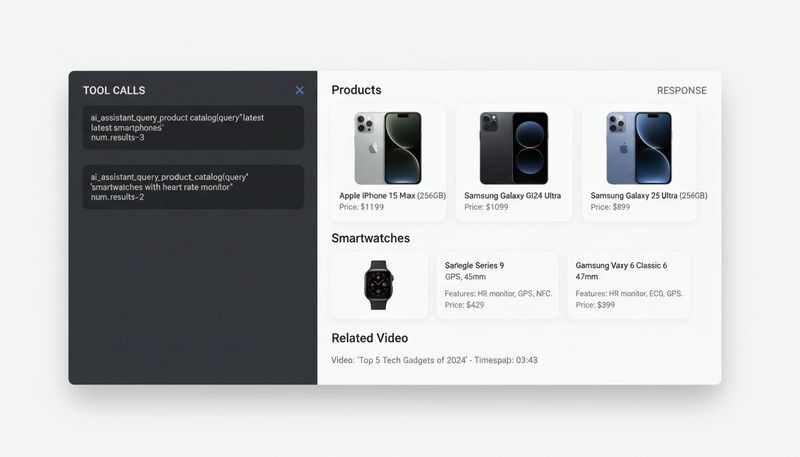
- Search and recommendation APIs. Endpoints that agents can call directly, ideally exposed as MCP-compliant tools or via UCP-compatible interfaces.
This is not a future checklist. Each item already affects native search, on-site search, paid shopping feeds, and SEO today. AI agent readiness piggybacks on the same foundations.
Search and Recommendation Readiness for Agentic Commerce
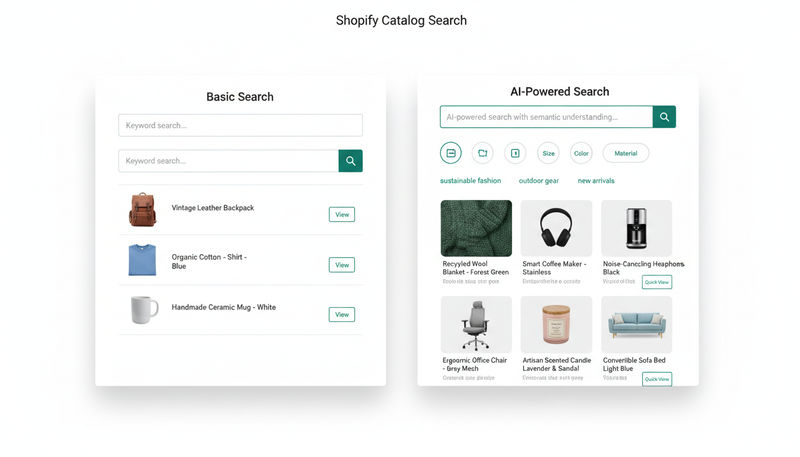
Clean data is the floor. The ceiling is whether the merchant's search and recommendation layer can serve agent-style queries — long, conversational, multi-criteria, ambiguous.
What the search stack needs:
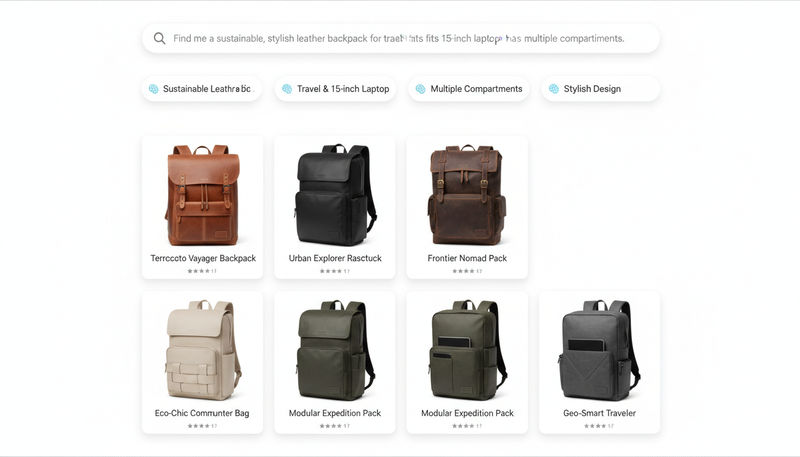
- Natural language understanding. The engine has to interpret "birthday gift for a coffee lover under three thousand" as a multi-criteria query (occasion, recipient, category, price), not a literal keyword string.
- Synonyms and typo tolerance. Agents pass on whatever the shopper said. Misspellings and regional variants should resolve correctly.
- Vector and semantic search. Embeddings let products match on meaning, so "comfortable running shoes for flat feet" surfaces stability sneakers even when the description never uses that phrase.
- Personalization. Agents pass session context. Ranking should adapt to the shopper's history, budget, and stated preferences.
- Recommendations. Related products, frequently bought together, and substitute recommendations are how an agent builds a shortlist instead of returning a single result.
- Analytics feedback loop. Every agent-driven query should feed back into the analytics pipeline so the team sees which conversational queries convert, which fail, and which need synonym or attribute fixes.
This is the closest-fit problem AI search and product discovery is built to solve — the same engine that serves on-site shoppers also serves agents, with the same relevance, personalization, and analytics layer.
Examples of Conversational Product Queries
A good test for catalog and search readiness is whether the stack handles real agent-style queries. A few representative ones:
- "Find me a waterproof jacket under five thousand for trekking." Requires category understanding, attribute filtering (waterproof), price filter, and use-case tagging (trekking).
- "Recommend a gift for a coffee lover." Requires intent decomposition (gift, recipient profile, category breadth) and personalized recommendation logic.
- "Show red party shoes available in size 7." Requires color and size variant matching plus real-time inventory.
- "Find laptop bags that fit a sixteen-inch MacBook." Requires structured compatibility data and dimension attributes, not just category match.
- "What's a good vitamin C serum for sensitive skin under fifteen hundred?" Requires ingredient attributes, skin-concern tags, and price filtering.
If the current stack returns weak or empty results on these, that is the gap to close — and it closes the same way regardless of which agent platform is asking.
A 90-Day Catalog Readiness Plan
A realistic sequencing for an ecommerce team starting from scratch:
Days 1–30 — data audit and cleanup. Inventory product titles, descriptions, and attributes across the catalog. Identify gaps (missing material, missing use case, inconsistent units). Backfill the top 20% of revenue-driving SKUs first.
Days 31–60 — structured data and APIs. Add Schema.org Product, Offer, AggregateRating, and Review markup site-wide. Expose search and recommendation endpoints. Document them in OpenAPI. If MCP or UCP integration is on the roadmap, plan the endpoints to match.
Days 61–90 — search relevance and analytics. Upgrade the search stack to support natural language queries, semantic ranking, personalization, and recommendation APIs. Wire analytics so conversational queries and conversion outcomes feed back into ranking and merchandising decisions.
At the end of 90 days, the catalog is no longer a data problem — it is an asset that AI shopping agents, on-site search, and SEO can all consume from the same foundations.
FAQs About AI Shopping Agents in Ecommerce
What are AI shopping agents?
AI shopping agents are conversational systems that help shoppers discover, compare, and buy products through natural-language interaction. They extract intent, query catalogs, rank candidates, and increasingly complete transactions on the shopper's behalf.
How is agentic commerce different from traditional ecommerce search?
Traditional search returns a list of products for the shopper to evaluate. Agentic commerce decomposes the query, applies multi-criteria filtering, ranks against preferences, and presents a shortlist with rationale — often inside a non-merchant surface like a chat assistant.
What is UCP and why does it matter?
The Universal Commerce Protocol is an open-source standard introduced by Google for connecting AI consumer surfaces, merchants, and payment providers. It defines how agents discover, query, and transact with commerce systems through APIs, A2A, and MCP. UCP-readiness reduces per-platform integration work.
How should ecommerce teams prepare their product catalog for AI agents?
Focus on data completeness and structure: titles, descriptions, attributes, variants, pricing, inventory, policies, FAQs, use-case tags, images, and Schema.org markup. Then ensure search and recommendation APIs serve conversational, multi-criteria queries.
Will AI shopping agents replace on-site search?
Not in the near term. Agent traffic supplements on-site search rather than replacing it. The same catalog and search infrastructure that serves agents also improves on-site conversion, so the investment pays back from both sides.
What is the single biggest blocker to AI agent discoverability?
Product data quality. Missing attributes, inconsistent variants, unstructured descriptions, and stale inventory are the most common reasons a catalog does not surface in agent-driven discovery — even when the search stack is capable.
Wrapping Up: How Seekora Prepares Catalogs for Agentic Commerce
AI shopping agents are not a separate channel that needs separate infrastructure. They consume the same product data, the same search relevance, and the same recommendation APIs that on-site discovery does — they just exercise them harder, in longer queries, with less margin for missing attributes. The merchants who treat this as a data and infrastructure investment now will surface in agent-driven discovery as the standards settle. The ones who wait for AI shopping to be "finalized" will be cleaning data while competitors collect the demand.
Seekora is built around exactly this readiness problem. The platform turns raw product data into a clean, machine-readable catalog with rich attribute coverage, then powers natural language search, semantic ranking, personalized recommendations, dynamic filters, and analytics over the same data — through APIs that agents can consume directly. Whether the next discovery surface is on-site search, a Shopify Agentic Storefront, a UCP-connected agent, or something not announced yet, the same Seekora foundation feeds them all. For ecommerce teams that want their catalog to be searchable, personalized, measurable, and ready for modern AI shopping experiences, that is the fastest way to close the readiness gap.
AI Shopping Agents in Ecommerce: Make Your Catalog Discoverable
- Why Ecommerce Discovery Is Moving Beyond the Search Box
- What AI Shopping Agents Actually Do
- What UCP and Agentic Storefronts Signal for Ecommerce
- Catalog Readiness Checklist for AI Agents
- Search and Recommendation Readiness for Agentic Commerce
- Examples of Conversational Product Queries
- A 90-Day Catalog Readiness Plan
- FAQs About AI Shopping Agents in Ecommerce
- What are AI shopping agents?
- How is agentic commerce different from traditional ecommerce search?
- What is UCP and why does it matter?
- How should ecommerce teams prepare their product catalog for AI agents?
- Will AI shopping agents replace on-site search?
- What is the single biggest blocker to AI agent discoverability?
- Wrapping Up: How Seekora Prepares Catalogs for Agentic Commerce
Stay ahead of the curve.
Subscribe to get the latest e-commerce insights and AI strategies delivered directly to your inbox.